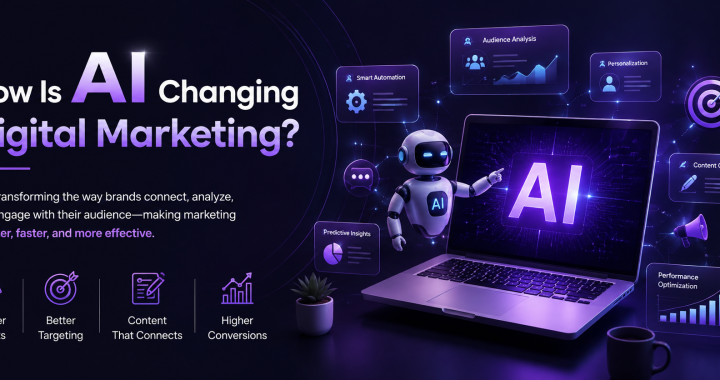
3. How Can AI Help Businesses Save Time and Grow Faster?
Introduction
For every business, time and resources are valuable. Employees often spend a significant amount of time on repetitive activities that do not directly contribute to business growth.
AI can help businesses reduce this workload by assisting with tasks such as data analysis, content creation, customer communication, and marketing automation. When these processes become more efficient, teams can spend more time focusing on customers, strategy, creativity, and growth.
How Does AI Save Businesses Time?
AI can assist with repetitive tasks that would otherwise require manual effort. Depending on the business, this may include organizing information, analyzing data, preparing reports, generating content drafts, and responding to common customer questions.
By reducing manual work, AI can help employees spend more time on tasks that require human judgment and creativity.
How Can AI Improve Content Production?
Businesses need content across websites, social media, email, advertisements, and other channels.
AI can assist with generating ideas, creating outlines, preparing drafts, and adapting existing content for different platforms. This can make the content-production process faster.
However, businesses should still review AI-assisted content to ensure it is accurate, useful, original, and consistent with their brand.
How Can AI Help Businesses Understand Customers?
Customer data can provide valuable information about interests, behavior, and preferences. AI can analyze large amounts of information and identify patterns that may be difficult to discover manually.
These insights can help businesses understand their audience and create more relevant marketing campaigns.
How Can AI Improve Customer Service?
Customers often want quick answers to simple questions. AI-powered chatbots and support systems can provide immediate responses to common questions and help customers find information.
This can reduce the workload on customer-service teams and allow employees to focus on more complicated customer issues.
How Can AI Support Business Growth?
AI does not automatically make a business grow. Instead, it can provide tools that improve efficiency, marketing, customer experience, and decision-making.
For example, a business that saves time through automation can use that extra time to improve its products, communicate with customers, develop new marketing campaigns, or explore new opportunities.
Growth comes from combining these efficiencies with a strong business strategy.
Should Every Business Use AI?
Not every business needs the same AI solutions. Businesses should first identify their specific problems and then choose technology that addresses those problems.
Using AI simply because it is popular may not provide meaningful results.
A better approach is:
Identify a problem → Choose a suitable AI solution → Test it → Measure results → Improve
Conclusion
AI can help businesses save time by reducing repetitive work, analyzing information, supporting content creation, and improving customer communication.
When combined with human expertise and a clear strategy, AI can help businesses become more efficient and create more opportunities for sustainable growth.
Frequently Asked Questions
Can AI really save business time?
Yes. AI can reduce manual work in areas such as content assistance, data analysis, reporting, and customer communication.
Can AI help a business grow?
AI can support growth by improving efficiency, customer understanding, personalization, and marketing processes, although it does not guarantee business growth.
Can small businesses use AI?
Yes. Small businesses can use AI to support marketing, customer service, content creation, automation, and data analysis.
How should a business start using AI?
Start by identifying a specific problem or repetitive task and then choose an AI solution that can address it.
4. How Can AI Make Content Creation Smarter and Easier?
Introduction
Content plays a major role in digital marketing. Businesses use blogs, social media posts, emails, advertisements, videos, website pages, and other forms of content to communicate with their audiences.
However, consistently creating useful content can be challenging. AI is changing the content-creation process by helping marketers generate ideas, organize information, create drafts, and improve their workflows.
How Does AI Help With Content Ideas?
Coming up with fresh content ideas can be difficult, especially when a business needs to publish regularly.
AI can help marketers brainstorm topics based on their industry, audience, products, services, and marketing goals. It can also help turn broad topics into specific content ideas.
However, marketers should choose ideas based on what is actually useful and relevant to their audience rather than publishing every idea generated by AI.
How Can AI Help With Content Planning?
A strong content strategy requires organization.
AI can assist marketers in creating content outlines, organizing topics, planning content calendars, and adapting content for different platforms.
For example, a single topic can be developed into a blog article, social media posts, an email, and short-form content. AI can help speed up this process while the marketer controls the overall strategy.
Can AI Help Write Content?
Yes. AI can assist with creating first drafts for different types of content.
It can help with blog introductions, social media captions, email drafts, advertisement variations, product descriptions, and other marketing materials.
However, AI-generated drafts should be reviewed carefully. Human writers and marketers should add expertise, examples, opinions, brand personality, and original insights.
How Does AI Improve Content Personalization?
Different customers have different interests and needs.
AI can help businesses analyze audience information and create more relevant content for different customer groups.
For example, a new visitor may need educational information, while an existing customer may be more interested in product updates or special offers.
Personalized content can make communication more relevant and useful.
Is AI-Generated Content Good for SEO?
AI itself does not automatically make content successful in search engines.
Good content should be created primarily for people and should provide genuine value. It should be accurate, relevant, useful, original, and easy to understand.
AI can assist with the content process, but marketers should focus on satisfying the audience’s needs rather than simply producing a large quantity of AI-generated pages.
Can AI Replace Content Writers?
AI can assist writers, but high-quality content still benefits from human creativity, experience, storytelling, editing, and critical thinking.
The strongest content strategy combines the speed of AI with the knowledge and creativity of people.
Conclusion
AI is making content creation faster and more organized by helping with ideas, planning, drafting, personalization, and repetitive content tasks.
But great content is not simply about producing words quickly. It is about creating something useful, original, relevant, and meaningful to the audience.
5. What Is the Future of AI & Automation in Digital Marketing?
Introduction
AI and automation are already changing digital marketing, but their role is likely to become even more significant. Businesses are exploring AI for customer insights, content assistance, advertising, personalization, analytics, and marketing automation.
The future of digital marketing will not simply be about using more technology. It will be about using technology intelligently while keeping customers and business goals at the center.
How Will AI Change Marketing in the Future?
AI is likely to become more integrated into everyday marketing workflows. Marketers may increasingly use AI to analyze information, identify opportunities, personalize communication, assist with content, and automate repetitive activities.
This can help marketing teams spend less time on manual processes and more time on strategy and creative work.
Will Marketing Become More Personalized?
Personalization is likely to become increasingly important.
AI can help businesses understand customer interests and behavior and use these insights to deliver more relevant content, recommendations, and communication.
Instead of treating every customer in exactly the same way, businesses can create experiences that better match different audiences.
What Role Will Automation Play?
Automation will continue to handle repetitive marketing processes.
Businesses may use automated workflows for areas such as email communication, lead management, reporting, customer support, and campaign processes.
The purpose of automation should be to improve efficiency while maintaining appropriate human oversight.
Will AI Change Search and SEO?
Search is evolving as AI becomes more involved in how people find and interact with information.
Marketers will need to focus on creating content that clearly answers user questions, demonstrates useful knowledge, and provides genuine value.
Traditional SEO fundamentals such as helpful content, clear organization, technical accessibility, and a good user experience will continue to matter.
Will AI Replace Digital Marketers?
AI will likely automate some repetitive tasks, but marketing still requires human skills.
Strategy, creativity, storytelling, brand building, communication, critical thinking, and understanding customer needs are difficult to reduce to simple automated processes.
Future marketers will therefore need to understand both marketing fundamentals and AI tools.
What Skills Will Future Marketers Need?
Marketers will increasingly benefit from AI literacy, data analysis, creative thinking, strategic planning, communication, and critical thinking.
Knowing how to use an AI tool will not be enough. Marketers will need to understand when to use it, how to evaluate its output, and how to connect it with real business goals.
How Can Businesses Prepare for the Future?
Businesses can start by identifying repetitive tasks and areas where AI could genuinely improve efficiency. They can then test suitable tools, train employees, measure results, and improve their processes.
Businesses should also pay attention to responsible technology use, accuracy, privacy, and human oversight.
The objective should not be “AI everywhere.”
It should be:
“AI where it creates real value.”
Conclusion
The future of digital marketing will be shaped by the combination of AI, automation, data, creativity, and human expertise.
Businesses that learn to use AI strategically can improve efficiency, understand customers better, and create more personalized experiences.
AI will provide powerful tools, but successful marketing will continue to depend on people who know how to turn those tools into meaningful strategies.